







ADA Drinking Fountain Requirements: Heights, Clearances & High-Low Rules
Posted by Anthony DiCicco on Aug 10th 2026
ADA drinking fountain requirements can be confusing because accessibility involves much more than mounting a water fountain at the correct height. The number of fountains provided, spout height, spout location, clear floor space, knee and toe clearance, controls, water flow, protruding-object rules, and accessibility for both wheelchair users and standing users can all affect compliance.
If you are looking to purchase now, visit or ADA Drinking Fountains category.
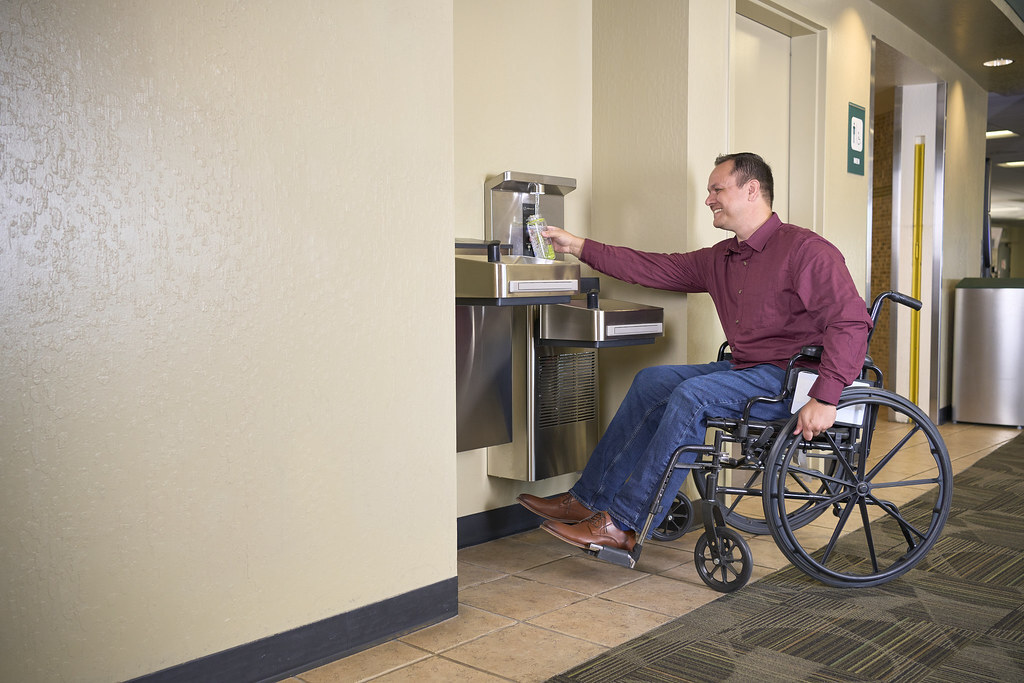
For architects, contractors, facility managers, schools, municipalities, and commercial building owners, understanding these requirements before equipment is ordered can help prevent expensive corrections, installation delays, and inspection issues later in the project.
This guide explains the major federal ADA drinking fountain requirements using the 2010 ADA Standards for Accessible Design and technical guidance published by the U.S. Access Board. State and local accessibility or building codes may also apply, so project-specific requirements should always be confirmed before installation.
ADA Drinking Fountain Requirements at a Glance
For most commercial projects, these are some of the most important ADA drinking fountain dimensions and requirements to verify.
| ADA Requirement | General Requirement |
|---|---|
| Wheelchair-accessible spout height | 36 inches maximum above finished floor or ground |
| Standing-person spout height | 38 inches minimum to 43 inches maximum above finished floor or ground |
| Clear floor space | 30 inches minimum by 48 inches minimum |
| Wheelchair approach | Forward approach centered on the accessible drinking fountain |
| Knee clearance width | 30 inches minimum |
| Knee clearance height | 27 inches minimum at the applicable location |
| Required toe clearance depth | 17 inches minimum |
| Spout from vertical support | 15 inches minimum |
| Spout from front edge | 5 inches maximum |
| Water stream height | 4 inches minimum |
| Control operating force | 5 pounds maximum |
| Protrusion into circulation path | Generally 4 inches maximum when the leading edge is more than 27 inches and not more than 80 inches above the floor |
These measurements should not be evaluated individually. A drinking fountain installation must satisfy all applicable requirements, not just the spout-height dimension.
Why ADA Drinking Fountains Often Use a High-Low Setup
One of the most misunderstood ADA drinking fountain requirements involves high-low or bi-level installations.
The federal standard is better understood as a requirement for two types of access: wheelchair access and standing-person access. ADA Section 211 addresses both.
Where the minimum number of drinking fountains is provided, one fountain generally must comply with the wheelchair-accessible requirements of Sections 602.1 through 602.6, while another must comply with the standing-person requirement in Section 602.7. One drinking fountain can substitute for two separate fixtures if the single unit satisfies both sets of requirements.
This is why bi-level drinking fountains are so common in schools, offices, healthcare facilities, airports, municipal buildings, and other public spaces.
What If More Than Two Drinking Fountains Are Installed?
When more than the minimum number of drinking fountains is provided, ADA Section 211.3 generally requires 50 percent to comply with the wheelchair-accessible requirements of Sections 602.1 through 602.6 and 50 percent to comply with the standing-person requirement in Section 602.7.
The Standards also contain a rounding provision when the 50 percent calculation results in a fraction. On larger sites, the U.S. Access Board recommends considering how the accessible units are distributed so users do not have to travel unnecessarily far to find the appropriate fountain.
ADA Drinking Fountain Height Requirements
There are two important spout-height ranges because the ADA addresses wheelchair users and standing users separately.
Wheelchair-Accessible Drinking Fountain Height
The spout outlet must be no more than 36 inches above the finished floor or ground.
The key word is spout. The ADA requirement does not simply tell the installer where to position the cabinet, basin, back panel, or mounting bracket.
Different drinking fountains have different bowl shapes, cabinet dimensions, mounting systems, and rough-in requirements. The manufacturer's installation drawing should be followed for the exact model being installed, and the final spout height should be verified after installation.
Standing Drinking Fountain Height
For a drinking fountain serving standing persons, the spout outlet must be at least 38 inches and no more than 43 inches above the finished floor or ground.
This higher drinking position provides access for standing users, including people who may have difficulty bending or stooping. A lower wheelchair-accessible fountain by itself does not necessarily satisfy the standing-person requirement.
ADA Clear Floor Space for Drinking Fountains
An accessible fountain is not useful if a wheelchair user cannot properly approach it.
ADA Section 602.2 requires a clear floor or ground space positioned for a forward approach and centered on the wheelchair-accessible drinking fountain. Knee and toe clearance complying with Section 306 must also be provided.
The basic clear floor space required by Section 305 is:
The space should remain free of obstacles and connect to an accessible route or another compliant clear floor or ground space.
Common objects that can interfere with accessible floor space include:
- Trash receptacles
- Recycling bins
- Benches
- Planters
- Vending equipment
- Cleaning carts
- Freestanding signs
- Storage or movable furniture
This becomes a facility-management issue after installation. A fountain can be properly installed and later become difficult to access because equipment or furniture is moved into the required approach area.
ADA Knee Clearance Requirements
Wheelchair-accessible drinking fountains generally require a forward approach. That means a user's knees must be able to extend beneath the fountain.
ADA Section 306 defines the required knee-clearance geometry. Key dimensions include:
- 30 inches minimum width
- 11 inches minimum depth at 9 inches above the floor
- 8 inches minimum depth at 27 inches above the floor
- 27 inches minimum knee-clearance height at the applicable location
Between 9 and 27 inches above the floor, the required knee-clearance depth may reduce according to the geometry established in Section 306.3.
This requirement helps explain why wall-mounted cantilevered drinking fountains are so common in wheelchair-accessible applications. The open area beneath the bowl can provide room for a user's knees and feet.
Common installation problem: A fountain may be designed for accessible applications, but plumbing, enclosures, protective panels, wall construction, or other objects can interfere with the required knee space after installation.
ADA Toe Clearance Requirements
Toe clearance works together with knee clearance so a wheelchair user can move far enough beneath the fountain to reach and use it comfortably.
Important dimensions include:
- 17 inches minimum required depth beneath the element
- 30 inches minimum width
- Toe-clearance space extends from the finished floor through 9 inches above the floor
- A maximum depth of 25 inches can be counted as toe clearance
This geometry is more detailed than simply confirming that there is "room under the fountain." For specification and installation purposes, follow the manufacturer's accessible installation drawing and verify the completed installation against the applicable ADA provisions.
ADA Drinking Fountain Spout Location
Spout height is only one part of the requirement. ADA Section 602.5 also regulates the position of the spout relative to the fountain.
- The spout must be at least 15 inches from the vertical support.
- The spout must be no more than 5 inches from the front edge of the drinking fountain, including bumpers.
These measurements help position the drinking point where a wheelchair user can reach it. A fountain can therefore have a spout below 36 inches and still fail to satisfy other ADA drinking fountain requirements.
ADA Water Flow Requirements
The ADA Standards also address the stream of water produced by the fountain.
ADA Section 602.6 requires a water flow at least 4 inches high. The spout must also be no more than 5 inches from the front of the fountain.
The maximum permitted stream angle depends on how far the spout is located from the front edge:
- If the spout is less than 3 inches from the front, the water-stream angle is limited to 30 degrees maximum.
- If the spout is between 3 and 5 inches from the front, the angle is limited to 15 degrees maximum.
The minimum stream height can also make it possible to place a cup beneath the water stream for a user who cannot drink directly from the fountain.
ADA Drinking Fountain Controls and the 5-Pound Rule
Drinking fountain controls are operable parts and must comply with applicable requirements of ADA Section 309.
Operable parts must be usable without:
- Tight grasping
- Pinching
- Twisting of the wrist
The operating force is limited to 5 pounds maximum, and controls must be located within the applicable accessible reach range.
Commercial fountains may use mechanical push buttons, push pads, electronic controls, or touchless sensors. The control type itself does not determine compliance. The completed installation still needs to satisfy the applicable reach and operation requirements.
Bottle Filling Stations and ADA Compliance
Bottle filling stations create one of the biggest areas of confusion in modern commercial hydration projects.
A bottle filling station does not automatically replace a required drinking fountain.
The U.S. Access Board explains that water coolers, bottle fillers, and nearby sinks cannot substitute for the wheelchair-accessible and standing drinking fountains required when drinking fountains are provided in applicable new construction, additions, or alterations.
Bottle fillers can instead be installed:
- Alongside drinking fountains
- Above compatible drinking fountains
- As part of an integrated drinking fountain and bottle filling station
- As part of a high-low hydration station
You can browse commercial bottle filling stations to compare available styles, but the complete installation should be reviewed when accessibility is part of the project.
Are Bottle Fillers Subject to ADA Requirements?
Fixed or built-in bottle fillers can be subject to ADA provisions that apply to operable parts and accessible use.
Depending on the installation, considerations can include:
- Location on an accessible route
- Clear floor space
- Reach range for controls
- Controls that do not require tight grasping, pinching, or twisting
- Maximum operating force for applicable hand controls
Bottle fillers are not simply treated as drinking fountains under every provision of Section 602. The U.S. Access Board distinguishes between the two, which is important when evaluating a complete hydration station.
Where Should a Bottle Filler Go on a High-Low Station?
If only one bottle filler is installed on a high-low drinking fountain station, the U.S. Access Board recommends locating the bottle filler at the wheelchair-accessible unit or bowl.
This is a practical accessibility recommendation when planning an integrated hydration station.
When comparing ADA drinking fountains and bottle filler combinations, consider the entire station as one system:
- Who will use the station?
- Where are the controls located?
- Can wheelchair users comfortably approach the bottle filler?
- Is the required clear floor space maintained?
- Does the higher fountain interfere with access to the lower fountain?
Can You Add a Bottle Filler to an Existing Drinking Fountain?
In many cases, an existing drinking fountain can be upgraded with a compatible bottle filler when the manufacturer offers a retrofit solution for that exact model.
However, adding a bottle filler does not automatically make an older drinking fountain ADA compliant.
Before ordering a retrofit, confirm:
- Exact manufacturer and model number
- Retrofit-kit compatibility
- Existing spout height
- Knee and toe clearance
- Clear floor space
- Control accessibility
- Electrical requirements
- Plumbing requirements
- Protrusion into the circulation path
Drinking Fountains and Protruding-Object Requirements
Protruding objects are easy to overlook when planning a wall-mounted drinking fountain.
Under ADA Section 307, an object with its leading edge more than 27 inches and not more than 80 inches above the finished floor or ground generally cannot project more than 4 inches horizontally into a circulation path.
This rule helps protect people who use canes from encountering objects that project into the walking path above the detectable range.
Depending on the drinking fountain and installation location, a unit may need to be recessed, located in an alcove, or otherwise positioned so it does not create a prohibited protruding object.
High-low stations deserve additional planning because the standing-height unit should not interfere with the wheelchair fountain's required approach and clear floor space.
Are Children's Drinking Fountains Different?
The ADA Standards include a specific exception for drinking fountains designed for children's use.
Under the exception to Section 602.2, a parallel approach can be permitted at a children's drinking fountain when:
- The spout is no more than 30 inches above the finished floor or ground.
- The spout is no more than 3 1/2 inches from the front edge of the unit, including bumpers.
Otherwise, the standard wheelchair-accessible drinking fountain requirement calls for a centered forward approach with applicable knee and toe clearance.
Schools should therefore avoid assuming that every lower-height fountain is governed by exactly the same criteria. The intended user group and installation conditions matter.
Do ADA Requirements Apply to Outdoor Drinking Fountains?
Yes. ADA Section 211 specifically addresses drinking fountains provided on exterior sites as well as those provided on a floor or within a secured area.
Outdoor drinking fountain projects add other considerations that may affect the complete installation:
- Accessible routes
- Ground surfaces
- Clear floor space
- Fountain mounting or pedestal configuration
- Protruding objects
- Freeze protection in cold climates
- Vandal-resistant components
- Drainage
- Pet-bowl placement when provided
An outdoor fountain designed for accessible use still needs to be installed within an accessible environment. A properly designed fountain surrounded by an inaccessible surface or disconnected from an accessible route does not solve the overall accessibility problem.
You can compare commercial outdoor drinking fountains for parks, schools, recreation areas, campuses, and other exterior applications.
ADA Requirements for Alterations and Replacement Fountains
Accessibility requirements are not limited to brand-new buildings.
Drinking fountain requirements can apply when units are altered, replaced, or added as part of a building alteration or addition. Alterations involving primary-function areas can also create accessible-path-of-travel obligations subject to the applicable ADA rules.
This is especially important when renovating:
- Schools
- Government buildings
- Office buildings
- Recreation centers
- Libraries
- Healthcare facilities
- Transportation facilities
- Commercial properties
ADA vs. State and Local Building Codes
The ADA Standards establish federal accessibility requirements, but they may not be the only requirements governing a commercial drinking fountain project.
Depending on the location and project, additional requirements may come from:
- State accessibility codes
- Local building codes
- Plumbing codes
- Adopted editions of the International Building Code
- ICC A117.1
- Local amendments
- Project specifications
- Requirements of the authority having jurisdiction
This is why a fountain should not be assumed to guarantee compliance in every project simply because the product is designed for accessible installations.
Common ADA Drinking Fountain Mistakes to Avoid
Most drinking fountain accessibility problems are preventable when they are identified during planning instead of after installation.
1. Checking Only the 36-Inch Spout Height
A 36-inch maximum wheelchair spout height is important, but it is not the complete ADA requirement. Clear floor space, knee and toe clearance, controls, spout location, water flow, protruding-object requirements, and scoping provisions must also be considered.
2. Installing Only the Lower Fountain
Wheelchair access does not eliminate the standing-person requirement where ADA Section 211 applies. This is one reason bi-level configurations are so common.
3. Assuming a Bottle Filler Replaces the Drinking Fountain
It does not. A bottle filling station and a drinking fountain serve different purposes under the ADA guidance.
4. Ordering Before Checking the Rough-In
Different drinking fountains have different mounting, plumbing, and electrical requirements. Confirm the exact model before the rough-in is finalized.
5. Ignoring Knee and Toe Space
Piping, covers, walls, enclosures, and other components can interfere with the required space beneath the fountain.
6. Blocking the Clear Floor Space
The required 30-by-48-inch clear floor area must remain usable. Furniture, trash receptacles, and equipment should not interfere with the approach.
7. Forgetting Protruding-Object Rules
Wall-mounted fountains extending into circulation paths may trigger the 4-inch protrusion limitation.
8. Treating "ADA Compliant" as a Product Feature Alone
A drinking fountain may be designed to support an accessible installation, but final compliance depends on how and where the product is installed.
ADA Drinking Fountain Checklist for Architects and Contractors
Use this checklist during planning and again before final inspection.
Scoping
- Determine where drinking fountains are being provided.
- Provide wheelchair and standing-person access as required by ADA Section 211.
- If using one combination unit, verify that it satisfies both applicable sets of requirements.
Wheelchair-Accessible Fountain
- Spout outlet is no higher than 36 inches.
- Required 30-by-48-inch clear floor space is provided.
- Clear floor space is centered for a forward approach.
- Knee clearance is maintained.
- Toe clearance is maintained.
- Spout location satisfies the applicable requirements.
- Water flow satisfies the applicable requirements.
Standing Fountain
- Spout outlet is between 38 and 43 inches above the finished floor or ground.
- Standing unit does not interfere with access to the wheelchair-accessible fountain.
Controls
- Controls are within the applicable accessible reach range.
- No tight grasping is required.
- No pinching is required.
- No twisting of the wrist is required.
- Operating force does not exceed 5 pounds where applicable.
Circulation and Installation
- An accessible route reaches the fountain.
- Required clear floor space is unobstructed.
- The fountain does not create a prohibited protruding object.
- Adjacent furniture or equipment does not interfere with access.
- Manufacturer installation instructions match the planned rough-in.
- Final dimensions are measured from the finished floor or ground.
Bottle Filler
- Bottle filler controls are accessible.
- Required clear floor space is provided where applicable.
- The bottle filler does not obstruct the drinking fountain.
- Retrofit compatibility is verified before ordering.
ProDrinkingFountains Expert Advice Before Ordering
One of the most important lessons in commercial drinking fountain projects is simple: do not choose a fountain based only on the words "ADA compliant" in a product description.
Start with the project and confirm:
- Who will use the fountain
- How many fountains are required
- Whether both wheelchair and standing access are being provided
- Available wall space
- Required clear floor space
- Rough-in dimensions
- Existing plumbing
- Electrical availability
- Whether a bottle filler is needed
- Whether the project is new construction, replacement, or retrofit
- Whether state or local accessibility provisions add requirements
Then select the equipment.
This process helps avoid one of the most expensive mistakes in commercial hydration projects: ordering a product first and trying to make the building accommodate it later.
For replacement projects, identify the existing manufacturer and exact model whenever possible. For new construction, coordinate the selected fountain with the architectural and plumbing drawings before rough-in.
For high-low stations, evaluate the bowls and bottle filler as one complete accessible hydration station rather than treating each component independently.
The ADA Drinking Fountain Numbers Worth Remembering
36 inches: Maximum wheelchair-accessible spout height.
38 to 43 inches: Standing-person spout height.
30 x 48 inches: Minimum basic clear floor space.
5 pounds: Maximum operating force for applicable controls.
4 inches: Minimum water-stream height.
4 inches: General maximum protrusion into a circulation path for objects within the applicable height range.
These numbers are useful reference points, but none should be evaluated in isolation. The safest approach is to review the applicable ADA sections together, follow the manufacturer's installation instructions for the exact drinking fountain, and confirm additional state, local, and project-specific requirements.
Why Buy Drinking Fountains From ProDrinkingFountains.com?
ProDrinkingFountains.com helps architects, contractors, facility managers, schools, universities, businesses, healthcare facilities, municipalities, parks, and other commercial buyers compare drinking fountains, bottle filling stations, filters, high-low configurations, outdoor fountains, replacement products, and hydration solutions.
Accessibility-focused projects can be confusing because the product, mounting height, surrounding space, bottle filler configuration, rough-in, and local requirements all have to work together.
Need help comparing an ADA drinking fountain, bi-level unit, bottle filling station, or replacement option? Call 888-503-7937 for product assistance or larger commercial project quotes.
ADA Drinking Fountain FAQs
What is the maximum ADA drinking fountain height?
For a wheelchair-accessible drinking fountain, the spout outlet must be no more than 36 inches above the finished floor or ground.
What height is a standing ADA drinking fountain?
The spout outlet for a drinking fountain serving standing persons must be at least 38 inches and no more than 43 inches above the finished floor or ground.
What is the ADA clear floor space for a drinking fountain?
The basic clear floor or ground space is at least 30 inches wide by 48 inches deep. At a wheelchair-accessible drinking fountain, the space is positioned for a forward approach and centered on the unit.
How much force can an ADA drinking fountain button require?
Applicable operable controls must require no more than 5 pounds of force and must not require tight grasping, pinching, or twisting of the wrist.
Do ADA drinking fountains need knee clearance?
Wheelchair-accessible drinking fountains generally require a forward approach with knee and toe clearance complying with the applicable ADA provisions.
Do you need both a high and low drinking fountain?
Where ADA Section 211 applies, access must be provided for wheelchair users and standing persons. This can be accomplished with separate fountains or a single combination unit that satisfies both sets of requirements.
Does a bottle filler count as an ADA drinking fountain?
No. A bottle filling station does not substitute for the required wheelchair-accessible or standing drinking fountain when those drinking fountain requirements apply.
Can an ADA drinking fountain have a manual push button?
Yes. A manual control can be used when it satisfies the applicable ADA requirements for reach, operation, operating force, and hand use.
Are outdoor water fountains subject to ADA requirements?
Yes. ADA drinking fountain scoping applies to exterior sites where drinking fountains are provided. The surrounding route, clear floor space, and complete installation must also be considered.
Do local building codes still matter if a drinking fountain follows ADA requirements?
Yes. Federal ADA requirements may apply in addition to state accessibility codes, local building codes, plumbing codes, adopted standards, and project-specific requirements. Always verify what applies to the specific project.
About the Author
Anthony DiCicco is part of the ProDrinkingFountains.com team and helps create practical product guidance for commercial drinking fountains, bottle filling stations, filters, water coolers, and facility hydration projects.
His work focuses on helping schools, contractors, architects, municipalities, offices, healthcare facilities, facility managers, and commercial buyers make clearer product decisions based on real-world use, installation needs, maintenance planning, accessibility considerations, and replacement compatibility.