








Refrigerated vs. Non-Refrigerated Drinking Fountains: Which Do You Need?
Posted by Tahnee Talley on Aug 24th 2026
When choosing a commercial drinking fountain, one of the first decisions is whether you need a refrigerated or non-refrigerated model.
The basic difference is simple. A refrigerated drinking fountain chills the incoming water before dispensing it. A non-refrigerated drinking fountain dispenses water at approximately the temperature supplied by the building's plumbing.
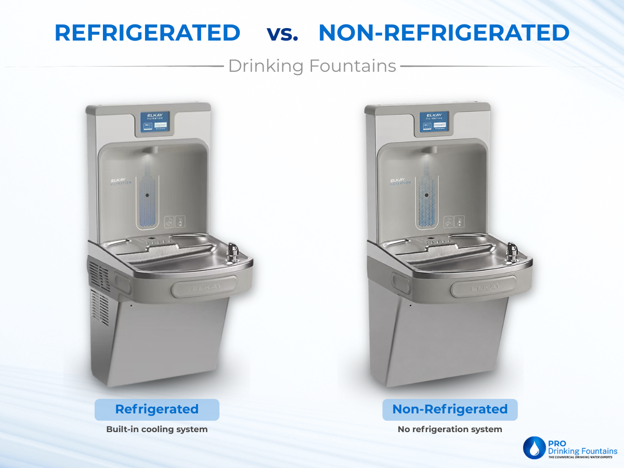
That difference affects more than water temperature. It can change the purchase price, electrical requirements, installation, energy use, maintenance needs, and even which locations make sense for the fountain.
For many facilities, refrigeration is worth having. For others, it adds cost and complexity without providing much benefit.
Here's how to decide.
What Is a Refrigerated Drinking Fountain?
A refrigerated drinking fountain contains a refrigeration system that cools the water before it reaches the bubbler or bottle filler.
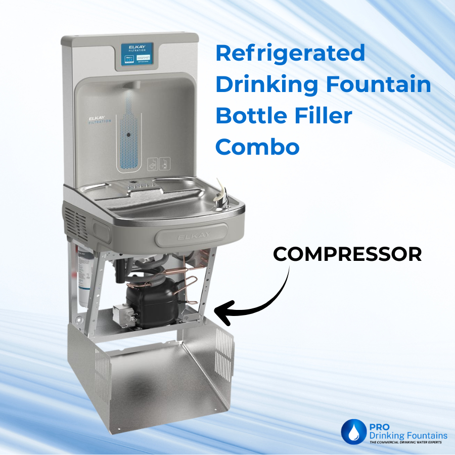
Depending on the model, this typically involves components such as a compressor, condenser, thermostat, and cooling tank or other heat-exchange components.
Because the fountain needs electricity to operate the refrigeration system, installation generally requires access to an appropriate electrical connection in addition to the water supply and drain.
Refrigerated fountains are common in:
- Schools and universities
- Offices
- Manufacturing facilities
- Gyms and recreation centers
- Healthcare facilities
- Airports and transportation facilities
- Other high-traffic commercial buildings
The primary advantage is straightforward: users receive consistently cooler drinking water rather than water that varies with the building's incoming supply temperature.
What Is a Non-Refrigerated Drinking Fountain?
A non-refrigerated drinking fountain does not actively chill the water.
Water travels from the building's supply line to the fountain and is dispensed without passing through a refrigeration system. The actual drinking temperature therefore depends heavily on the temperature of the incoming water.
That doesn't necessarily mean the water will be warm.
In some buildings and climates, incoming municipal water is already relatively cool. In those situations, adding refrigeration may provide less benefit than you would expect.
Non-refrigerated fountains are commonly considered when:
- Electrical service is unavailable or inconvenient
- Lower equipment cost is a priority
- Energy consumption needs to be minimized
- Incoming water is already sufficiently cool
- The fountain will see relatively light use
- The application does not require chilled drinking water
Their simpler construction can also mean fewer mechanical components to maintain over the life of the fountain.
Refrigerated vs. Non-Refrigerated Drinking Fountains at a Glance
| Consideration | Refrigerated | Non-Refrigerated |
|---|---|---|
| Chills drinking water | Yes | No |
| Requires electricity for chilling | Yes | No refrigeration power requirement |
| Initial equipment cost | Generally higher | Generally lower |
| Energy consumption | Higher | Lower |
| Refrigeration components to maintain | Yes | No |
| Installation complexity | Generally higher | Generally lower |
| Best for consistently cold water | Yes | No |
| Dependent on incoming water temperature | Less | More |
Exact requirements vary by model. Always check the manufacturer's specifications before purchasing or planning an installation.
The Biggest Factor: Incoming Water Temperature
One of the most overlooked considerations is the temperature of the water entering the fountain.
A non-refrigerated drinking fountain doesn't make water warm. It simply doesn't make it colder.
If your building receives naturally cool water and the supply line remains in conditioned space, users may find a non-refrigerated fountain perfectly comfortable.
The situation can be very different in a warm building, hot climate, or installation where the supply piping is exposed to higher temperatures.
This is why choosing between refrigerated and non-refrigerated models based only on equipment price can be a mistake.
How Much Traffic Will the Fountain Receive?
Traffic is another important consideration.
A drinking fountain in a small office may only be used occasionally throughout the day. A fountain between classes in a large school can experience many users within a short period.
Refrigerated fountains have rated cooling capacities, and those capacities are not unlimited.
If you're purchasing a refrigerated model for a high-traffic location, don't assume that every refrigerated fountain will perform equally well. Compare the manufacturer's cooling-capacity specifications and the conditions under which those ratings were established.
This becomes particularly important when a bottle filling station is involved because filling bottles can consume substantially more water at once than taking a short drink from a bubbler.
Don't Forget About Electricity
Electrical requirements depend on more than whether a drinking fountain is refrigerated or non-refrigerated.
Refrigerated drinking fountains require electrical power to operate the cooling system. However, many non-refrigerated models also require electricity. For example, units with electronic bottle filler sensors or other electronic controls still need an electrical connection even though they do not chill the water.
Generally, the drinking fountains that can operate without electricity are mechanically activated non-refrigerated models. These use a mechanical push button or similar activation method and do not rely on powered electronic components.
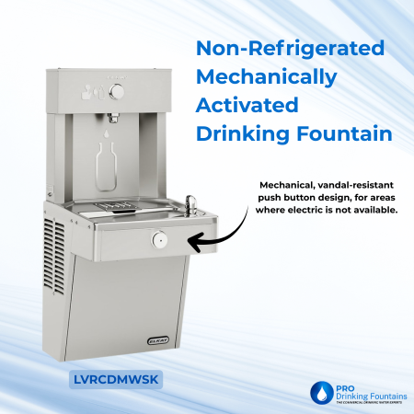
This distinction is especially important when replacing an older fountain or planning a new installation. Don't assume that choosing a non-refrigerated model eliminates the need for electrical service.
Before ordering, determine:
- Whether the model is mechanically or electronically activated
- Whether electrical service is required
- The voltage and other electrical requirements of the specific model
- Whether the necessary electrical service is already available at the installation location
- Where the receptacle or electrical connection must be located
- Whether the installation must meet additional local electrical requirements
Running new electrical service can add considerably to the total project cost, especially in retrofit applications where the work may involve opening walls or coordinating multiple trades.
If avoiding electrical work is one of the goals of the project, look specifically for a non-refrigerated, mechanically activated drinking fountain rather than assuming any non-refrigerated model will operate without power.
Maintenance Differences
Refrigeration adds components, and additional components create additional potential maintenance points.
A refrigerated fountain may eventually require diagnosis or service involving its cooling system. A non-refrigerated fountain eliminates that entire group of components.
That doesn't make non-refrigerated fountains maintenance-free. Both types may still have components such as valves, bubblers, push buttons, sensors, drains, and filters depending on the model.
But if chilled water provides little value at a particular location, avoiding refrigeration can simplify long-term ownership.
What About Bottle Filling Stations?
The same decision applies when choosing a drinking fountain with a bottle filling station.
A bottle filler mounted above a refrigerated drinking fountain may dispense chilled water depending on how that specific system is designed. Non-refrigerated configurations dispense water without active chilling.
This distinction deserves extra attention because bottle filling stations can dispense a larger volume of water during each use.
For a busy school, gym, warehouse, or public facility where users routinely fill large bottles, chilled water can be a meaningful amenity.
For a low-traffic office where employees mainly want convenient access to potable water, refrigeration may be less important.
Always verify the water path and refrigeration specifications of the exact bottle filling station you're considering rather than assuming the bottle filler and bubbler operate identically.
You can compare commercial bottle filling stations to see the different configurations available.
When Does a Refrigerated Drinking Fountain Make Sense?
A refrigerated model is generally worth considering when cold drinking water is an important part of the user experience.
Typical examples include schools, gyms, recreation facilities, factories, warehouses, and high-traffic public buildings.
Refrigeration can also make sense when incoming water tends to be warmer than users would find desirable.
Another practical consideration is expectations. If you're replacing an existing refrigerated fountain that building occupants have used for years, switching to a non-refrigerated model may technically provide the same access to drinking water but still feel like a downgrade to users.
When Does a Non-Refrigerated Drinking Fountain Make More Sense?
Non-refrigerated fountains can be an excellent choice when chilled water isn't necessary for the application.
Consider one when:
- Incoming water is already reasonably cool
- Chilled water isn't expected or necessary at the location
- Reducing energy consumption is a priority
- You want to eliminate the refrigeration system and its associated components
- Lower equipment cost is an important consideration
Non-refrigerated models can be especially practical when the added cost and complexity of a refrigeration system don't provide a meaningful benefit for the facility.
A Common Replacement Mistake
When replacing an existing drinking fountain, don't assume you should simply order whichever model looks most similar.
First determine whether the existing fountain is refrigerated.
Then ask whether you actually want to keep that configuration.
Replacing refrigerated with refrigerated is often the simplest decision when occupants expect cold water and the necessary electrical service is already present.
But an old fountain replacement is also an opportunity to reconsider the application. If refrigeration hasn't provided meaningful value, a non-refrigerated replacement may simplify the equipment. Conversely, replacing a non-refrigerated fountain with a refrigerated model may require electrical work that wasn't part of the original installation.
Wall dimensions, plumbing locations, electrical requirements, mounting heights, and existing rough-ins should all be checked before ordering a replacement.
Does ADA Compliance Depend on Refrigeration?
No. Refrigeration and accessibility are separate considerations.
A drinking fountain does not become ADA compliant simply because it is refrigerated or non-refrigerated.
Accessibility depends on factors such as the fountain's configuration, mounting, clear floor space, controls, spout location, and other applicable requirements.
When selecting equipment for an accessible installation, evaluate the accessibility requirements independently from the decision about refrigeration.
You can also compare ADA drinking fountains and bi-level drinking fountains when accessibility is part of the project plan.
Which Type Should You Choose?
For most projects, the decision comes down to four questions:
1. Do Users Expect Cold Water?
If cold drinking water is important for the facility, choose a refrigerated model.
2. What Is the Incoming Water Temperature?
If the building already supplies pleasantly cool water, refrigeration may offer limited additional benefit.
3. Is Electrical Service Already Available?
If not, include the cost and complexity of adding it when comparing options.
4. How Heavily Will the Fountain Be Used?
For busy locations, consider both the value of chilled water and the cooling capacity of the specific refrigerated model.
The mistake is assuming that refrigerated automatically means "better."
It means the fountain provides an additional function. Whether that function is worth paying for depends on the building, installation, climate, traffic level, and expectations of the people using it.
Need Help Choosing a Drinking Fountain?
If you're replacing an existing drinking fountain or planning a new installation, start with the application rather than a specific model.
Identify whether you need refrigeration, bottle filling capability, filtration, accessibility features, and the appropriate configuration for your installation. Then compare models that meet those requirements.
Taking a few minutes to verify those details before ordering can prevent an expensive mismatch and help you choose a drinking fountain that makes sense for the facility long after installation.
Need help comparing refrigerated and non-refrigerated drinking fountains? Call 888-503-7937 for product assistance or help with larger commercial projects.
About the Author
Tahnee Talley is part of the ProDrinkingFountains.com team and helps create practical product guidance for commercial drinking fountains, bottle filling stations, water coolers, filters, replacement products, and facility hydration projects.
Her work focuses on helping customers better understand product differences, installation considerations, maintenance requirements, replacement options, and the details that can affect choosing the right commercial hydration equipment for a facility.