



The Ultimate Guide to Commercial Bottle Filling Stations & Drinking Fountains
Posted by The ProDrinkingFountains Team on Nov 3rd 2025
Why Hydration Stations Are Replacing Traditional Fountains
Clean, accessible drinking water is a necessity in schools, offices, healthcare facilities, gyms, airports, warehouses, and other commercial buildings. Traditional drinking fountains still have an important role, but many facilities are adding or replacing them with commercial bottle filling stations that make it easier to refill reusable bottles quickly.
Today's hydration equipment can combine bottle filling, traditional drinking fountains, filtration, refrigeration, touchless activation, bottle counters, and accessibility features in a single installation. The right configuration depends on the building, expected traffic, plumbing, available electrical service, water quality, maintenance needs, and local code requirements.
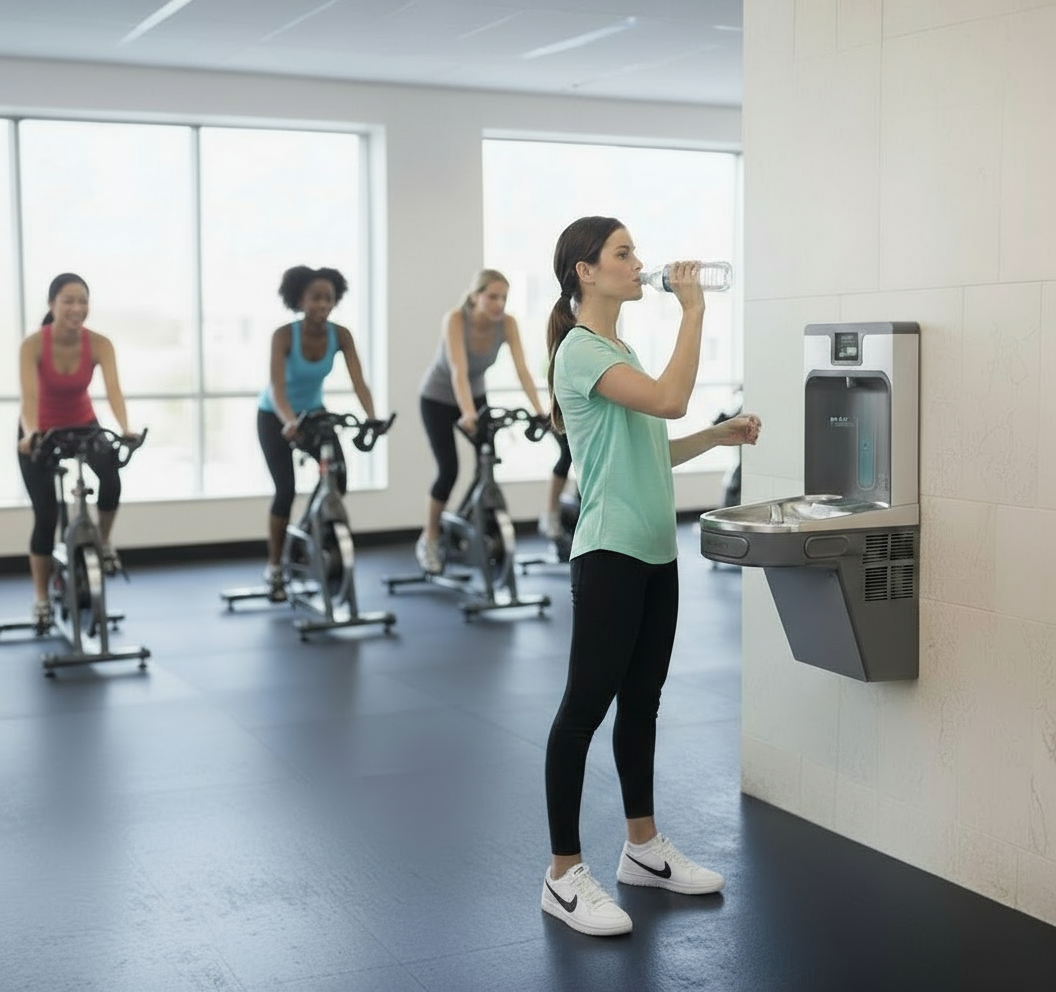
This guide explains the major bottle filler and drinking fountain choices, including chilled vs non-chilled systems, filtration, installation styles, current school drinking-water requirements, leading brands, maintenance, and accessibility considerations.
Jump directly to the section you need.
Types of Commercial Bottle Filling Stations
Choosing the right bottle filler starts with the physical installation. Commercial systems are available in several very different configurations.
Wall-Mounted Combination Stations
Common in schools, offices, healthcare facilities, and public buildings. These systems typically combine a bottle filler with one or two drinking fountains or water coolers.
Standalone Wall-Mounted Bottle Fillers
A good option when direct bottle filling is needed without a traditional bubbler. Models may be surface-mounted or partially recessed depending on the design.
Recessed and In-Wall Stations
These systems provide a cleaner architectural appearance and can reduce projection into hallways. Installation usually requires adequate wall-cavity space and careful planning for plumbing, electrical service, and service access.
Retrofit Bottle Fillers
Retrofit kits can add bottle-filling capability to certain existing drinking fountains or water coolers. Compatibility matters, so identify the existing manufacturer and model before ordering.
Floor-Standing and Point-of-Use Systems
Freestanding hydration equipment can work well in offices, break rooms, healthcare environments, warehouses, and other locations where a traditional wall-mounted fountain is not the best fit.
Outdoor Bottle Filling Stations
Outdoor models are designed for parks, campuses, recreation areas, schools, and other exterior applications. In freezing climates, a standard outdoor model may need to be shut down and winterized unless it is specifically designed as freeze-resistant.
Chilled vs Non-Chilled Bottle Filling Stations
Refrigeration is one of the most important decisions because it affects user experience, installation requirements, energy use, equipment cost, and future maintenance.
| Feature | Chilled / Refrigerated | Non-Chilled / Non-Refrigerated |
|---|---|---|
| Water Temperature | Uses refrigeration equipment to cool incoming water | Dispenses water at or near incoming supply temperature |
| Electrical Requirement | Electrical power is required for the refrigeration system | Refrigeration power is not required, but electronic sensors, lights, counters, or controls may still require electricity depending on the model |
| Maintenance | Includes refrigeration components in addition to normal fixture maintenance | Simpler when no refrigeration system is present |
| Common Applications | Schools, gyms, offices, healthcare, high-use indoor areas | Facilities where existing water temperature is acceptable, many outdoor installations, and projects prioritizing lower energy use |
Do not assume that every non-refrigerated bottle filler operates without electricity. Mechanical models may require no electrical connection, while touchless bottle fillers and models with electronic displays or bottle counters commonly do.
Filtered vs Unfiltered: What Actually Matters?
A filtered bottle filler can improve taste and odor and, when equipped with the appropriate certified filter, reduce specific contaminants such as lead. The important point is to match the filter's certifications and reduction claims to the needs of the facility.
Two standards commonly seen in commercial drinking-water filters are:
- NSF/ANSI 42 for aesthetic effects such as chlorine taste and odor and certain particulate claims, depending on the filter certification
- NSF/ANSI 53 for specific health-related contaminant reduction claims, which can include lead when the filter is certified for that reduction
Some newer commercial filtration systems carry additional certifications for other contaminants. Always review the certification and performance data for the exact cartridge rather than assuming all filters from a manufacturer provide the same contaminant reduction.
For more detail, see our commercial water fountain filter guide and our bottle filler filter replacement guide.
School Drinking Water Requirements Vary by State
School drinking-water requirements are evolving, but the rules are not the same nationwide. Some states focus on filtration, some on lead testing and remediation, and others include bottle filling stations in particular construction or modernization projects.
Michigan
Michigan's Filter First laws require K-12 public and nonpublic schools and licensed child-care centers to manage consumptive fixtures, use approved lead-reducing point-of-use filtration, and test filtered water. The major installation deadlines have now passed: child-care centers were required to furnish water to children from filtered sources by October 24, 2025, and schools were required to have approved filters on consumptive fixtures by the end of the 2025-2026 school year. Ongoing sampling and filter maintenance remain part of compliance.
Michigan schools and child-care providers can learn more in our Michigan Filter First Law Compliance Guide.
California
California Education Code Section 38041 requires water bottle filling stations in certain K-12 new-construction and modernization projects submitted to the Division of the State Architect when the statute's project and school-facilities bond conditions apply. Modernization projects covered by the law require at least one bottle filling station at the school, while covered new-school construction requires at least one bottle filling station per 350 people. The law also allows bottle filling stations to be combined with drinking fountains.
New York
New York requires schools covered by its lead-testing program to sample applicable outlets for lead on a three-year compliance cycle. The current action level is 5 parts per billion. An outlet that exceeds the action level requires appropriate response and remediation under the state's requirements.
Top Commercial Brands: Elkay, Halsey Taylor, Oasis, Haws, and Murdock
There is no single best bottle filling station for every building. The strongest choice depends on the installation, desired features, existing equipment, and service requirements.
| Brand | What to Know | Filtration | Common Applications |
|---|---|---|---|
| Elkay | Broad commercial lineup including ezH2O bottle fillers, coolers, retrofit systems, architectural configurations, and newer high-capacity filtration options | Multiple filtered configurations and cartridge systems depending on model | Schools, offices, healthcare, public buildings, gyms |
| Halsey Taylor | Long-established commercial hydration brand with drinking fountains, water coolers, and HydroBoost bottle filling options | Filtered configurations available; verify the cartridge required for the exact model | Education, institutional, commercial facilities |
| Oasis | Wide range of VersaFiller, VersaCooler, QUASAR, and newer Essence hydration products | Current Oasis systems include VersaFilter III and additional filtration options on compatible models | Schools, offices, commercial buildings, healthcare |
| Haws | Strong commercial and institutional lineup with indoor, outdoor, retrofit, filtered, refrigerated, and RIVIVE hydration options | Filtered models and configurable filtration are available depending on series | Industrial, public, education, recreation, outdoor applications |
| Murdock | Commercial H2O-to-Go bottle fillers plus durable indoor, outdoor, and specialty fountain configurations | Filtration options vary by product and installation | Parks, schools, public buildings, recreation, high-use facilities |
Oasis is a good example of why older filter descriptions should not be carried forward indefinitely. Current Oasis literature prominently features its VersaFilter III system, including a replacement cartridge certified to NSF/ANSI 42 and 53 with a rated capacity of up to 4,750 gallons. Newer compatible Oasis systems can also accept additional specialty filtration cartridges.
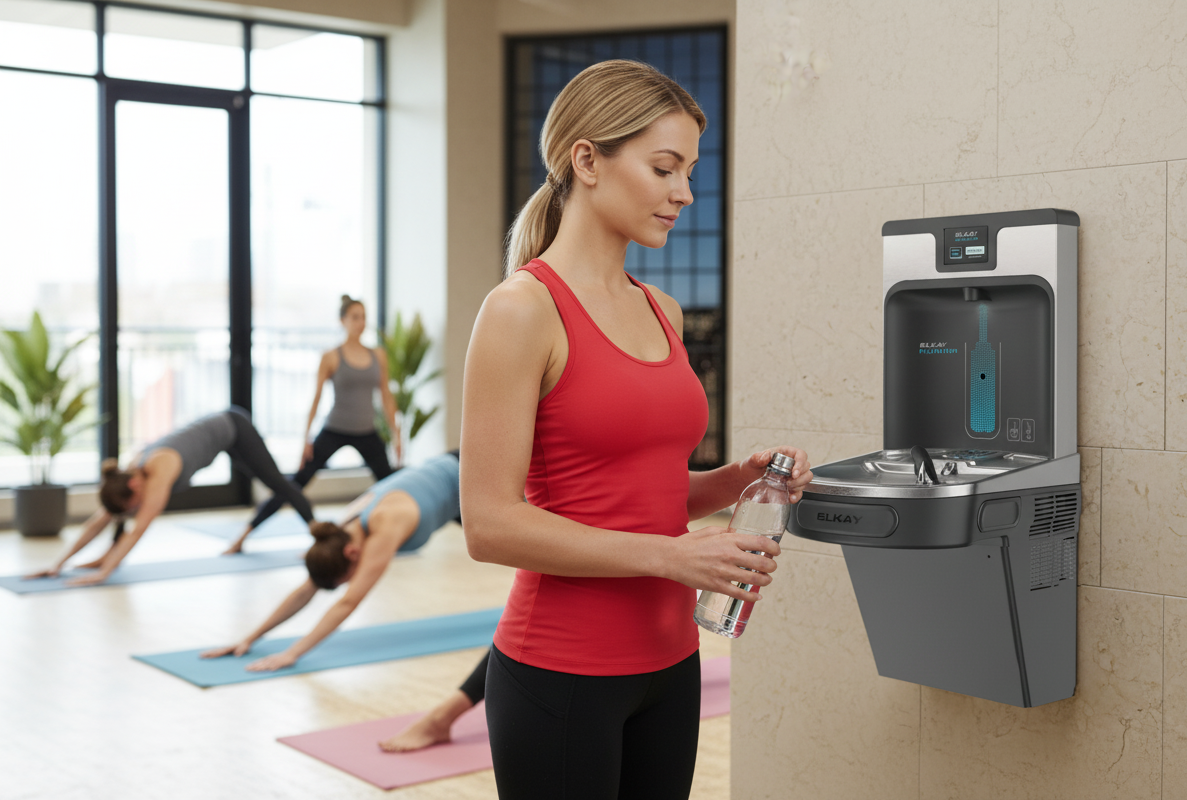
Choosing the Right Bottle Filling Station for Your Facility
A good specification starts with the building, not the brand name. Work through these questions before narrowing down models.
1. What Is Already Installed?
If you are replacing or retrofitting an existing fountain, record the manufacturer, model number, plumbing arrangement, voltage if applicable, wall construction, drain location, and available space.
2. How Much Traffic Will the Station Handle?
A low-use office and a school hallway between classes place very different demands on a hydration station. Consider cooling capacity, filling speed, filter capacity, and ease of service for high-use locations.
3. Is Refrigerated Water Needed?
If users expect chilled water, choose a refrigerated model or a compatible bottle filler and remote chiller arrangement. If incoming water temperature is acceptable, a non-refrigerated design can eliminate the refrigeration system.
4. Is Filtration Required?
Determine whether filtration is being selected for taste and odor, lead reduction, another contaminant concern, or a specific compliance requirement. Then match the filter certification to that need.
5. Is Touchless Activation Important?
Sensor-operated bottle fillers are popular in commercial environments, but they may require electrical service even when the unit is non-refrigerated.
6. What Are the Accessibility Requirements?
Select an appropriate product configuration and confirm mounting height, clear floor space, knee and toe clearance where applicable, reach ranges, protrusion limits, and other project-specific requirements.
7. How Will the Unit Be Serviced?
Think about filter access, shutoff access, refrigeration service, drain cleaning, and how easily maintenance staff can reach components after the surrounding wall and cabinetry are finished.
Maintenance and Filter Replacement Tips
There is no universal commercial bottle filler filter interval. Filter capacities vary by manufacturer, cartridge, contaminant claim, water quality, and usage. Some systems may be rated for a few thousand gallons, while newer high-capacity commercial systems can be rated substantially higher.
Use the replacement interval and capacity specified for the exact filter installed in your equipment.
- Record the bottle filler model and replacement filter part number
- Follow the manufacturer's gallon capacity and time-based replacement guidance
- Replace filters sooner when required by water conditions, pressure loss, flow reduction, or applicable regulations
- Flush new filters according to manufacturer instructions
- Reset filter monitors or status indicators after cartridge replacement when applicable
- Clean bottle-filling alcoves, drains, bubblers, and high-touch surfaces as part of routine maintenance
- Follow manufacturer procedures after extended shutdowns or long periods of non-use
- Keep maintenance and filter-replacement records when required by your facility or local regulations
If you are unsure which cartridge your equipment uses, our Bottle Filler Filter Replacement Guide covers common Elkay, Halsey Taylor, and Oasis systems and explains how to identify the correct replacement.
ADA, Accessibility, and Installation Considerations
Commercial drinking fountains and bottle filling stations are often installed as part of an accessible route, but ADA compliance is determined by more than one measurement on the product.
Depending on the fixture and installation, accessibility considerations can include:
- Spout height and location for accessible drinking fountains
- Clear floor space for wheelchair approach
- Knee and toe clearance where a forward approach is required
- Operable-part reach ranges for controls and activation points
- Protruding-object limits in circulation paths
- Standing-person access where required when multiple drinking fountains are provided
- Local plumbing and building-code requirements in addition to federal accessibility rules
For that reason, avoid selecting a bottle filler based only on an "ADA" label in a product name. The model, mounting height, surrounding clearances, adjacent drinking fountain configuration, and finished installation all matter.
ProDrinkingFountains.com Helps You Get It Right
Commercial hydration equipment can be surprisingly difficult to match. Similar-looking models may differ in refrigeration, filtration, voltage, activation method, mounting style, fountain configuration, finish, or compatibility with existing equipment.
ProDrinkingFountains.com specializes in commercial drinking fountains, water coolers, bottle filling stations, filters, and replacement equipment from leading manufacturers including Elkay, Halsey Taylor, Oasis, Haws, and Murdock.
Our team can help you compare:
- Refrigerated vs non-refrigerated models
- Filtered vs non-filtered configurations
- New installations vs retrofit options
- Single-level vs bi-level fountain combinations
- Indoor vs outdoor equipment
- Touchless vs mechanical activation
- Replacement filters and compatible accessories
Frequently Asked Questions
What is the difference between a bottle filler and a drinking fountain?
A bottle filler is designed to dispense water directly into a reusable container. A drinking fountain is designed for direct drinking through a bubbler. Many commercial hydration stations combine both functions.
Can I add a bottle filler to an existing drinking fountain?
Sometimes. Retrofit bottle fillers are available for many existing water coolers and fountains, but compatibility depends on the manufacturer, model, age, physical configuration, plumbing, and sometimes electrical requirements.
Does a non-refrigerated bottle filler need electricity?
Not necessarily, but some do. A mechanical non-refrigerated bottle filler may operate without electrical power, while models with touchless sensors, bottle counters, lights, or electronic controls can require electricity even though they do not chill the water.
How often should a bottle filler filter be replaced?
Follow the manufacturer specification for the exact cartridge. Filter life varies considerably by model, rated capacity, water quality, usage, and regulatory requirements. There is no single replacement interval that applies to every commercial bottle filling station.
Do all filtered bottle fillers remove lead?
No. Check the certification for the exact filter. If lead reduction is required, choose a cartridge specifically tested and certified for lead reduction under the applicable standard.
Are bottle filling stations required in California schools?
California requires bottle filling stations in certain K-12 new-construction and modernization projects submitted to the Division of the State Architect when the conditions in Education Code Section 38041 apply. It is not a blanket requirement stating that every existing California school must install a bottle filling station.
What does Michigan Filter First require?
Michigan's Filter First laws require covered K-12 schools and licensed child-care centers to manage drinking-water fixtures, use approved point-of-use lead-reducing filtration at consumptive fixtures, maintain the filters, and conduct ongoing testing according to the state's requirements.
Do outdoor bottle fillers need to be winterized?
Standard outdoor fixtures in freezing climates may need seasonal shutdown and winterization. Freeze-resistant models use specialized designs and installation requirements, so verify whether the exact product is intended for freezing conditions.
Final Thoughts
The best commercial bottle filling station is not simply the newest or most expensive model. It is the one that fits the building, expected traffic, water temperature needs, filtration requirements, plumbing and electrical conditions, maintenance plan, and accessibility requirements.
Whether you are replacing one aging drinking fountain or planning hydration equipment for an entire facility, ProDrinkingFountains.com can help you compare commercial bottle fillers, water coolers, drinking fountains, and replacement filters before you order.