






Hospital Drinking Fountains & Bottle Filling Stations: Healthcare Facility Guide
Posted by Anthony DiCicco on Sep 29th 2026
Drinking Fountains and Bottle Filling Stations for Hospitals and Healthcare Facilities
Choosing a drinking fountain or bottle filling station for a hospital is different from simply choosing a popular commercial water cooler. Hospitals, medical offices, outpatient clinics, rehabilitation facilities, behavioral health centers, and other healthcare buildings can have very different hydration requirements depending on where the fixture will be installed and who will use it.
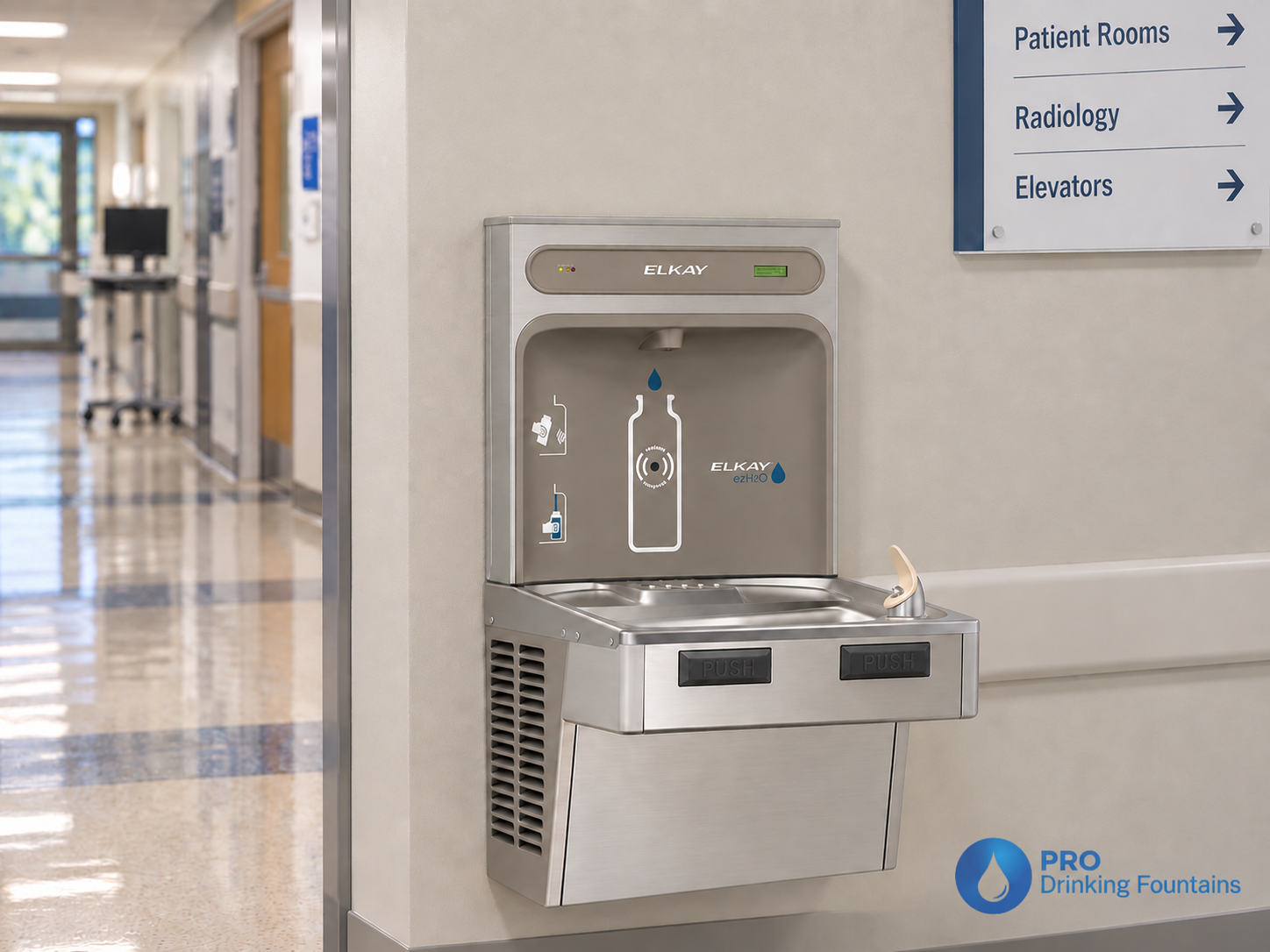
A public hospital corridor may need a high-capacity filtered bottle filling station with convenient drinking access. A clinic may prioritize a compact touchless bottle filler. A renovation may require a surface-mounted unit that works with existing utilities. A behavioral health environment can require an entirely different level of patient-safety consideration, including specialized ligature-resistant fixture design.
The goal should not be to find a product simply labeled for "hospital use." Instead, healthcare facilities should match the drinking water equipment to the location, users, accessibility requirements, water quality goals, activation method, maintenance program, installation conditions, and patient-safety needs of that particular area.
What Should a Hospital Look for in a Drinking Fountain or Bottle Filling Station?
The right drinking water station depends on the specific healthcare environment. A product that works well in a hospital lobby may not be appropriate for a behavioral health unit, and a fixture selected for staff use may have different requirements from one installed in a public corridor.
For most hospital and healthcare hydration projects, start with these questions:
- Will the fixture serve patients, visitors, staff, or a combination of users?
- Is direct drinking access required in addition to bottle filling?
- Is touchless activation preferred?
- Should the water be filtered?
- Is chilled water required?
- What accessibility requirements apply to the installation?
- How much daily traffic will the station receive?
- How easily can maintenance personnel access filters, drains, refrigeration components, and controls?
- Is vandal resistance or unusually heavy-duty construction important?
- Is the fixture being installed in a behavioral health or other patient-safety-sensitive environment?
Answering those questions first is more useful than searching for a single product marketed broadly as a hospital water fountain.
| Healthcare Priority | Features to Consider |
|---|---|
| Reduced hand contact | Sensor-activated bottle filling or fully touchless operation where available. |
| Water quality | Properly selected and maintained filtration appropriate for the facility's water-quality goals. |
| Accessibility | Accessible mounting, controls, clear floor space, knee and toe clearance, and drinking access as required for the project. |
| High traffic | Commercial construction, appropriate cooling capacity, durable components, and convenient filter/service access. |
| Cleanability | Durable surfaces, practical basin design, proper drainage, and access for routine cleaning. |
| Patient safety | Application-specific fixture design, including purpose-built ligature-resistant products where required. |
Important Features for Healthcare Drinking Water Stations
Touchless Bottle Filling
Sensor-activated bottle fillers allow users to refill a bottle without pressing a shared activation button. This can reduce contact with frequently touched controls and is one reason touchless hydration equipment is common in healthcare facilities and other high-traffic commercial buildings.
It is important to distinguish between a touchless bottle filler and a fully touchless drinking station. Many combination units use a sensor for the bottle filler while the drinking fountain still uses a mechanical push bar or push button.
If reduced-contact activation is a priority, review our selection of hands-free drinking fountains and touchless bottle filling stations and verify how each portion of the fixture is activated.
Laminar Bottle-Filling Flow
Many modern commercial bottle fillers use laminar flow to create a smooth stream of water with minimal splash during bottle filling. This can make the station cleaner and easier to use in busy corridors and public areas.
Drain Design
Drainage is easy to overlook during product selection. Some commercial bottle filling stations incorporate a drain system that carries incidental water away instead of allowing it to remain in the bottle-filling area.
For healthcare facilities, evaluate the complete plumbing and drainage arrangement rather than selecting a fixture only from its appearance.
Stainless Steel and Durable Commercial Construction
Stainless steel is common in commercial hydration equipment because it provides a durable surface suitable for frequent use and routine cleaning. Heavy-use locations may also benefit from vandal-resistant bubblers, protected controls, reinforced construction, or other durability features.
Choosing Hydration Equipment for Different Areas of a Hospital
A large healthcare campus may use several types of drinking fountains and bottle filling stations rather than standardizing on one fixture for every location.
Hospital Lobbies and Public Waiting Areas
Public areas often experience steady traffic from visitors, patients, employees, contractors, and vendors. Combination units that provide both bottle filling and direct drinking access can serve a broad group of users without requiring separate fixtures.
Features worth considering include filtered water, chilled water, touchless bottle filling, accessible configuration, filter-status monitoring, durable surfaces, and convenient maintenance access.
Hospital Corridors
Wall-mounted drinking fountains and bottle filling stations can work well in corridors, but protrusion into circulation paths, clear floor space, accessibility, available wall depth, and service access all need to be considered.
A recessed or in-wall bottle filling station can reduce the amount of equipment projecting from the wall, while a surface-mounted design may simplify certain renovation projects where opening or rebuilding the wall is undesirable.
Staff Areas and Break Rooms
Staff hydration areas may place greater emphasis on fast bottle filling, filtration, refrigeration, and high daily capacity. Depending on the location and applicable requirements, a dedicated bottle filler may make sense where conventional drinking-fountain access is already provided elsewhere.
Outpatient Clinics and Medical Offices
Smaller healthcare locations may not need the same capacity as a major hospital. Compact wall-mounted or surface-mounted bottle fillers can be useful where space is limited, while combination units provide both bottle filling and direct drinking access in one installation.
Rehabilitation and Long-Term Care Facilities
Accessibility deserves particular attention anywhere users may have limited mobility. Product selection should be coordinated with the complete accessible route, approach area, controls, drinking-fountain configuration, and mounting requirements for the project.
Are Touchless Bottle Filling Stations Better for Hospitals?
Touchless activation can be a valuable feature in hospitals because users can refill bottles without pressing a shared bottle-filler control. It also provides a convenient modern user experience in high-traffic areas.
However, touchless operation should be treated as one design feature rather than the sole criterion for choosing healthcare hydration equipment.
Also consider:
- Whether the drinking fountain portion is also touchless
- Sensor power requirements
- Automatic shutoff timing
- Bottle-filling flow rate
- Filtration
- Drainage
- Refrigeration
- Maintenance access
- ADA and other applicable accessibility requirements
A sensor-operated filler with difficult filter access or the wrong installation configuration may still be a poor choice for the project.
Should Hospital Bottle Filling Stations Be Filtered?
Many healthcare facilities choose filtered bottle filling stations, but filtration should be selected according to the facility's water supply, water-quality objectives, product specifications, maintenance capability, and any applicable facility policies or project requirements.
Commercial drinking water filters can be certified for reduction of specific contaminants or water-quality concerns, but not every filter removes the same substances. The certification and rated capacity of the exact replacement cartridge matter.
Facilities should also plan for filter maintenance before the unit is purchased. Consider:
- Filter capacity
- Filter-status indicators
- Replacement interval
- Replacement-cartridge availability
- Front, side, or rear service access
- Who will be responsible for filter changes
- Whether filter changes need to be documented by the facility
For a deeper explanation of filter certifications, cartridge identification, capacities, replacement timing, and manufacturer-specific filters, use our commercial drinking fountain and bottle filler filter guide.
ADA and Accessibility Considerations in Healthcare Facilities
Hospitals and healthcare buildings frequently serve people with a wide range of mobility needs, making accessibility an essential part of hydration-station planning.
A product described as ADA compliant or ADA capable still needs to be installed correctly. Depending on the project, requirements can involve drinking-fountain scoping, spout height, clear floor space, knee and toe clearance, control operation, reach, protruding objects, and access for both wheelchair users and standing persons.
Bottle fillers also create an important distinction: a bottle filling station does not automatically substitute for drinking-fountain access that may be required by the applicable accessibility standard or building code.
Rather than repeating the dimensional requirements here, see our complete ADA drinking fountain requirements guide for spout heights, high-low configurations, clear floor space, knee clearance, toe clearance, controls, bottle fillers, and protruding-object considerations.
Behavioral Health Drinking Fountains and Ligature-Resistant Bottle Fillers
Behavioral health environments require a separate discussion because a conventional commercial drinking fountain may not be appropriate in every patient-accessible location.
Manufacturers including Murdock produce purpose-built ligature-resistant drinking fountains and bottle filling stations intended for facilities where reducing potential ligature attachment points is part of the fixture-selection process.
Depending on the model, these specialized fixtures may incorporate design elements such as:
- Sloped or specially shaped surfaces
- Ligature-resistant bubbler designs
- Reduced attachment points
- Heavy-duty stainless steel construction
- Concealed or specialized activation systems
- Recessed or semi-recessed configurations
- Tamper-resistant components
This is a fundamentally different application from choosing a touchless bottle filler for a public hospital lobby.
For conventional commercial and specialty bottle-filling configurations from this manufacturer, browse our Murdock bottle filling stations. Contact us if your healthcare project has specialized behavioral-health requirements that are not shown online.
Surface-Mounted, Recessed, or Combination Hospital Hydration Station?
Installation style can make a major difference in a healthcare renovation or new-construction project.
Surface-Mounted Bottle Fillers
Surface-mounted units can be useful when wall depth is limited or when opening the wall is undesirable. They may also simplify some retrofit projects, although utilities, clearances, protrusion limits, and accessibility still need to be evaluated.
Recessed and In-Wall Bottle Fillers
Recessed stations can provide a cleaner architectural installation and reduce projection from the wall. They are particularly worth considering during new construction or substantial renovation when the wall can be planned around the fixture and future service requirements.
Bottle Filler and Drinking Fountain Combination Units
Combination stations provide reusable bottle filling and conventional drinking access in one coordinated fixture. These are common choices for public corridors, waiting areas, clinics, and other locations serving a broad population.
Retrofit Bottle Fillers
Some existing drinking fountains can accept a compatible retrofit bottle filling station. This may allow a healthcare facility to add bottle filling without replacing the entire cooler.
Compatibility must be verified using the exact manufacturer and model number. A retrofit that physically resembles the existing fountain is not necessarily compatible with it.
Examples of Drinking Water Stations to Consider for Healthcare Facilities
The following products illustrate different approaches to healthcare hydration. They are not the only models that can work in hospitals, and the correct choice depends on the installation, required features, utilities, accessibility requirements, and facility policies.
| Example | Useful Features | Potential Healthcare Application |
|---|---|---|
| Elkay LMABFDWSSK ezH2O | Filtered bottle filling, touchless bottle-filler activation, laminar flow, real drain, filter monitor, antimicrobial-treated key plastic components, ADA configuration. | General hospital corridors, waiting areas, clinics, and other indoor areas where filtered bottle filling plus direct drinking access is desired. |
| Halsey Taylor HTHBSM-WF HydroBoost | Surface-mount configuration, filtration, touchless sensor activation, laminar flow, real drain and filter-status monitoring. | Healthcare renovations and locations where a filtered bottle filler is desired but available wall depth is limited. |
| Haws 1211SFH | Filtered chilled water, sensor-operated bottle filling, hands-free drinking-fountain operation, stainless steel construction, high-capacity commercial design and ADA configuration. | High-traffic indoor healthcare spaces where filtration, chilled water and reduced-contact operation are priorities. |
| Murdock Bottle Fillers | Commercial stainless steel configurations, sensor-operated models, filtration options, surface-mount and other specialized designs. | Projects requiring durable commercial equipment or specialized configurations. Murdock also manufactures purpose-built ligature-resistant products for behavioral health applications. |
Healthcare buyers can also compare the broader Halsey Taylor bottle filling station and Haws bottle filling station selections to compare filtered, touchless, refrigerated, recessed, surface-mounted, high-low, and retrofit configurations.
Planning a Hospital Bottle Filling Station Project
Healthcare projects are easier when the fixture is selected before plumbing, electrical work, wall construction, and finish work are finalized.
Before ordering, gather the following information:
- Installation location. Identify the exact hospital, clinic, office, rehabilitation, staff, public, or behavioral-health environment.
- Primary users. Determine whether the station will serve patients, visitors, staff, children, wheelchair users, or a broad public population.
- Existing equipment. For replacement projects, record the manufacturer and complete model number of the existing fountain.
- Available utilities. Confirm water supply, drain, voltage, electrical access, and available wall or floor space.
- Filtered or non-filtered. Determine the facility's filtration goals and who will maintain the cartridges.
- Refrigerated or non-refrigerated. Decide whether the station must chill the incoming water or can use building-supplied water at its existing temperature.
- Activation method. Confirm whether touchless bottle filling, fully touchless operation, or mechanical activation is preferred.
- Accessibility. Review the product and completed installation against all applicable requirements.
- Service access. Make sure filters, refrigeration equipment, valves, drains, sensors, and other service components will remain accessible after installation.
- Patient-safety requirements. Identify behavioral-health or other special environments before selecting conventional commercial fixtures.
Hospital Renovations: Do You Need to Replace the Existing Drinking Fountain?
Not necessarily. An existing hospital drinking fountain may sometimes be upgraded with a compatible bottle filler, while other projects are better served by replacing the entire fixture.
Replacement may make more sense when the existing unit has an aging refrigeration system, inaccessible configuration, difficult-to-source parts, damage, outdated plumbing, poor service access, or no compatible bottle-filler retrofit.
For retrofit projects, always identify the existing model number before ordering. Bottle-filler retrofit kits are manufacturer- and model-specific, and visual similarity alone is not enough to confirm compatibility.
Call 888-503-7937 or chat with the ProDrinkingFountains.com team. If you are replacing existing equipment, have the manufacturer, model number, photos, desired features, and installation location available. We can help narrow the commercial drinking fountain and bottle filling station options that fit your project.
Frequently Asked Questions About Hospital Drinking Fountains and Bottle Filling Stations
What type of drinking fountain is best for a hospital?
There is no single drinking fountain that is best for every hospital location. Public corridors and waiting areas may benefit from filtered combination bottle fillers and drinking fountains, while staff areas may prioritize high-capacity bottle filling. Behavioral health areas may require specialized ligature-resistant fixtures. The correct product depends on the location, users, utilities, accessibility requirements, maintenance program, and facility safety requirements.
Are there drinking fountains made specifically for healthcare facilities?
Some manufacturers specifically market commercial hydration equipment for hospitals, clinics, and medical offices, while many conventional commercial drinking fountains can also be appropriate for healthcare applications. Behavioral health environments are different because manufacturers offer specialized ligature-resistant fixtures designed for patient-safety-sensitive locations.
Should hospitals use touchless bottle filling stations?
Touchless bottle fillers are commonly considered for healthcare facilities because users can refill bottles without pressing a shared bottle-filler control. However, touchless activation is only one factor. Filtration, accessibility, drainage, refrigeration, maintenance access, capacity, and installation requirements should also be evaluated.
Are hospital bottle filling stations filtered?
They can be, but filtration is not universal. Hospitals can choose filtered or non-filtered bottle filling stations depending on their water supply, water-quality objectives, facility policies, maintenance capabilities, and project requirements. Always verify what the exact filter is certified to reduce.
Do hospitals need refrigerated drinking fountains?
Not necessarily. Refrigerated water coolers chill the incoming drinking water, while non-refrigerated units dispense water at the temperature supplied by the building. The correct choice depends on user expectations, building water temperature, electrical availability, energy use, maintenance preferences, and project specifications.
Can a bottle filling station replace a drinking fountain in a hospital?
Do not assume that it can. A bottle filler provides reusable-bottle access but does not automatically substitute for drinking-fountain access required by applicable accessibility standards, building codes, or project requirements. The complete project should be reviewed before removing or replacing required drinking fountains.
What is a ligature-resistant drinking fountain?
A ligature-resistant drinking fountain is a specialized fixture designed to reduce potential attachment points that could be used for self-harm. These products may use sloped surfaces, specialized bubblers, tamper-resistant construction, recessed designs, concealed controls, and other patient-safety-oriented features. They are commonly considered for behavioral health and similar patient-safety-sensitive environments.
Are antimicrobial drinking fountains available for healthcare facilities?
Some commercial drinking fountains and bottle fillers use antimicrobial agents in specific components such as mouth guards or key plastic surfaces. These features apply only to the treated components and do not make the complete fixture sterile or replace routine cleaning, maintenance, or facility infection-control procedures.
Can an existing hospital water cooler be upgraded with a bottle filler?
Sometimes. Manufacturers offer retrofit bottle fillers for certain existing drinking fountains and water coolers. Compatibility depends on the exact manufacturer, model, utilities, mounting arrangement, and retrofit kit. Identify the model number before ordering.
What brands make drinking fountains and bottle fillers suitable for healthcare projects?
Commercial manufacturers such as Elkay, Halsey Taylor, Haws, Oasis, and Murdock offer drinking fountains, water coolers, bottle filling stations, filtration systems, ADA configurations, touchless models, and other products that may be appropriate for healthcare facilities. The correct manufacturer and model depend on the specific application.
The Bottom Line
Hospitals do not need a single universal category of "hospital-safe" drinking fountain. They need commercial hydration equipment selected for the requirements of each location.
In public and clinical areas, that may mean filtered water, touchless bottle filling, accessible drinking access, durable construction, controlled splash, practical drainage, and easy maintenance. In renovations, installation depth and compatibility with existing utilities may drive the decision. In behavioral health environments, patient-safety considerations can require purpose-built ligature-resistant equipment rather than a conventional commercial fountain.
The most effective approach is to define the application first and compare specific drinking fountains and bottle filling stations second.
ProDrinkingFountains.com supplies commercial hydration equipment from leading manufacturers including Elkay, Halsey Taylor, Haws, Oasis, and Murdock. Our team can help hospitals, clinics, contractors, architects, facility managers, and healthcare organizations compare configurations based on filtration, refrigeration, accessibility, activation method, installation type, maintenance requirements, and project conditions.
Anthony DiCicco is the founder of ProDrinkingFountains.com and has worked with commercial drinking fountains, bottle filling stations, water coolers, filtration products, and facility hydration equipment for more than two decades. Through ProDrinkingFountains.com, he helps contractors, facility managers, schools, healthcare organizations, municipalities, businesses, and other commercial buyers identify equipment for new construction, replacement, retrofit, and specialized hydration projects.